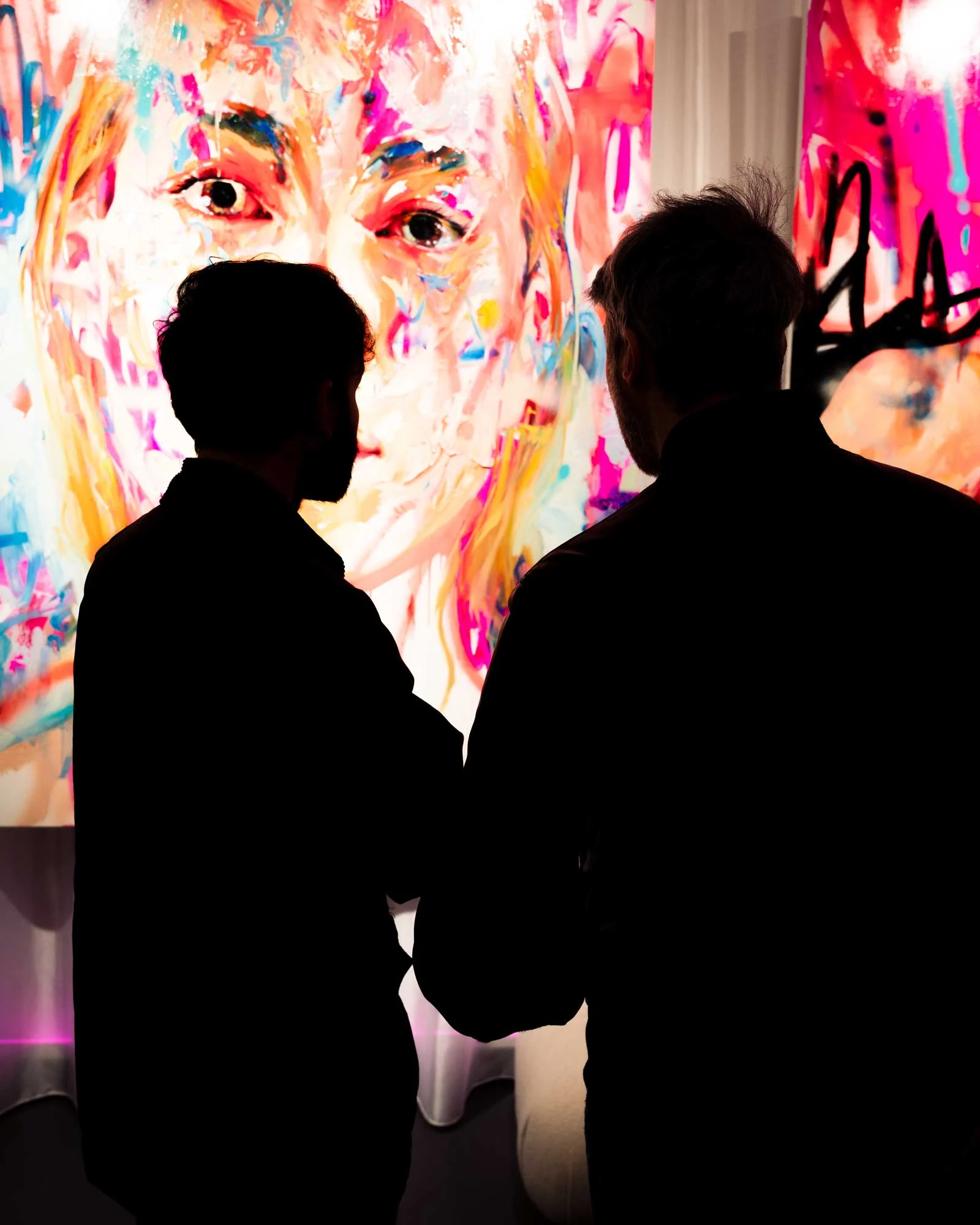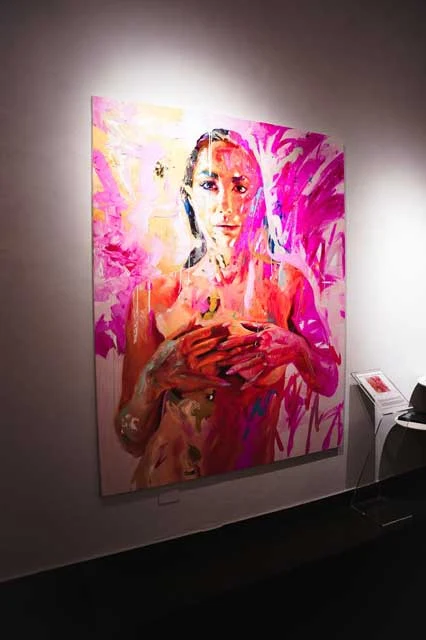
Fabio Abbreccia’s style draws on the great figurative tradition of the late twentieth century, particularly British painting, from Bacon and Freud to Jenny Saville.
The constant attempt to fix an image, a snapshot in matter, a moment’s vision, and the unease this produces generate a violent, dynamic gesture: a persistent attempt to destroy and deconstruct the figure, which takes shape through continual movement, a perpetually ongoing present.
Only the ruins of the figure emerge, through a meticulous exploration of colour, the sole indulgence that brings the work close to a vibrant realism that is never firmly sought. This obsessive investigation of the human figure, particularly the female figure, goes beyond mere depiction, bringing together the rhythm of volumes and carefully studied anatomy in a universal graphic balance whose lines of force often prevail over representation.
Since 2020, his work has been included in the prestigious catalogue of Liquid Art System gallery.
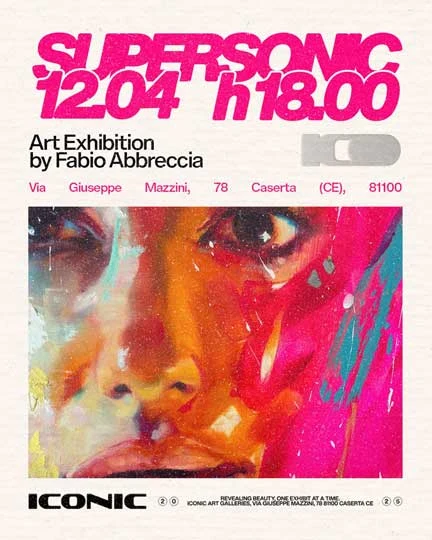
Supersonic
Critical text by Giuseppe Maria Marrone
I try to ask myself whether a work of art has a soul, then I look at Fabio Abbreccia’s work and things become more complicated, because a form of expression appeals to both my taste and that of the public: Pop art.
Pop art can mean many things, yet in the shared imagination of art history it seems predominantly equated with the absence of the subject, of that substratum that is not merely functional but indispensable to the presence of a soul.
What, then, is Fabio Abbreccia’s Pop soul?
First, let us try to understand what a soul is. We might define it as the immaterial essence of the human being, for some also the seat of emotions and consciousness. How, then, could a soul inhabit an object, a work of art, and moreover one belonging to Pop art? That Pop art which denies the depths of human consciousness, at least as an aesthetic of surface?
Abbreccia does not align himself with the Pop world in the sense of a literal translation of its lessons. He proposes something entirely new.
This novelty lies in the semantic scope of Pop art’s own research. Abbreccia does not clash with the traditional idea of art as subjective expression; indeed, this is immediately apparent in the eyes of his figures, their faces, bodies and lines. But is Abbreccia Pop? Yes, that too, and much more. The subject breaks in and asserts itself through the reality of feeling rather than emotion, because emotional energy is digested and transformed into feeling. Abbreccia’s art is therefore wholly human.
The reference is once again to a contemporary dream. When the lights come on and reveal the human reality impressed in the depicted figures, the modern historical condition emerges forcefully: not a world of human subjects, but masks that seem to replicate endlessly. Conformity, the industrial seriality of the human subject, the unconscious Pop side of today’s subject, imposes itself by depriving human beings of metacognition, reducing them to replicants of the shadow, the collective image through which, to invoke Plato’s Republic, Book VII, we “see” the world. Here “seeing” is the act of understanding that projects us into the world and becomes our approach to life. We humans exist as the product of action both performed and endured, because the shadows are simulacra projected by a society that empties consciousness and flattens thought. Abbreccia is an anomaly in this process of Pop understanding: a conscious short circuit that counters deception with a carefully explored inner dimension made of fire, the light we await, and feeling.
How does Fabio Abbreccia reach this moment? The phenomenology of perceiving his works revolves around the immediate stimulation of the sensory and neural faculties involved in the search for colour.
The architecture of the works rests on their chromatic structure. Warm and cool colours sublimate the energy they carry into a feeling that is the hidden story behind every face. The subjects’ life experiences emerge forcefully, illuminating Abbreccia’s fundamental premise: an original intuition of the subject’s uniqueness. Here lies the revolution against seriality in Pop art, which disrupts the fluid, identity-eroding processes of today’s society, giving light a vibrant meaning: illuminating truth and transforming it from an electromagnetic wave into a ringing perception of colour that generates understanding.
Abbreccia’s thick brushwork acts on figures and faces in a way that once again conveys powerful energy, so much so that the figures seem to come alive: the soul appears.
Abbreccia is the author of a soul that seeks life through colour and finds it when the human being awakens from a contemporary dream.