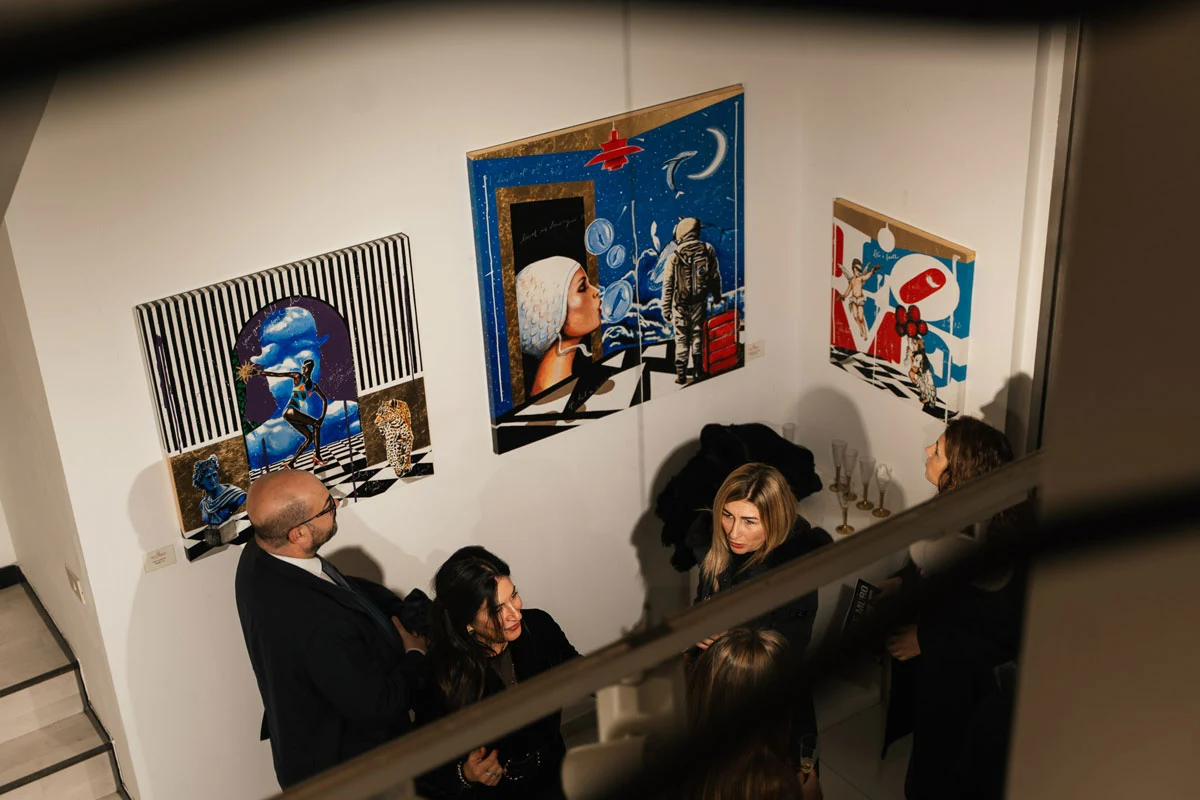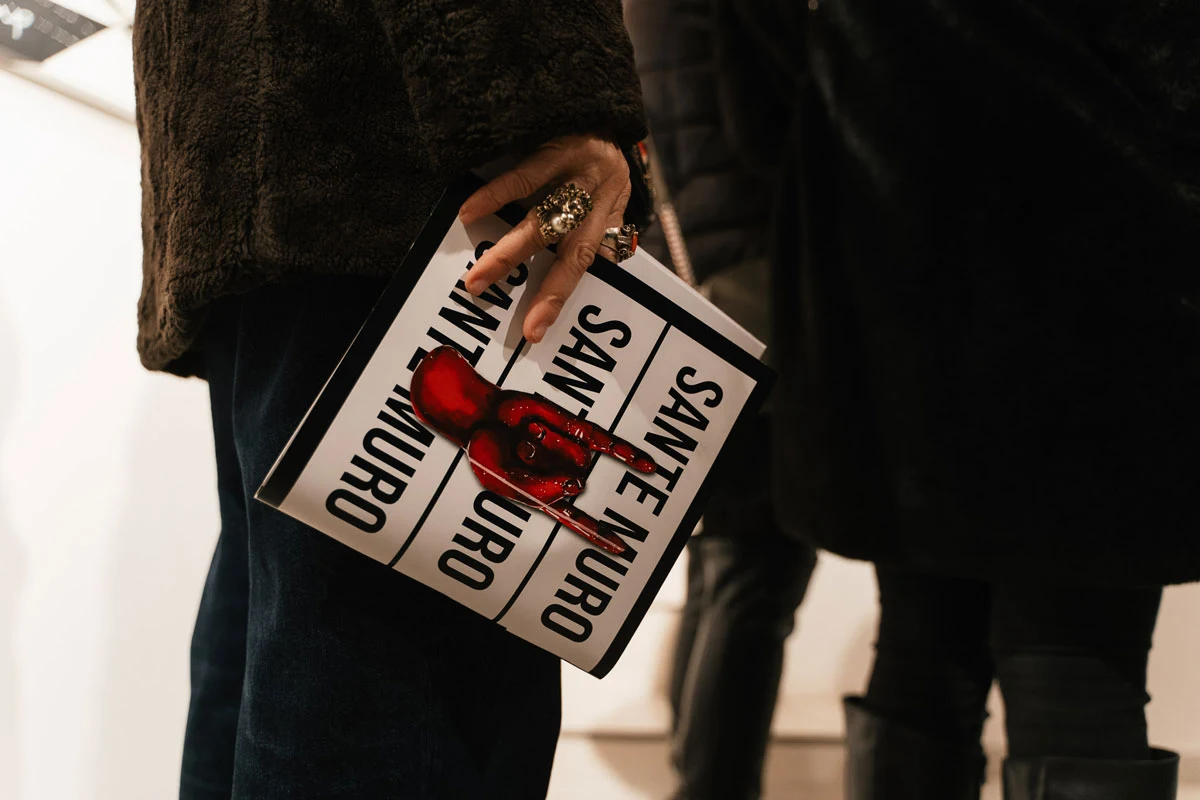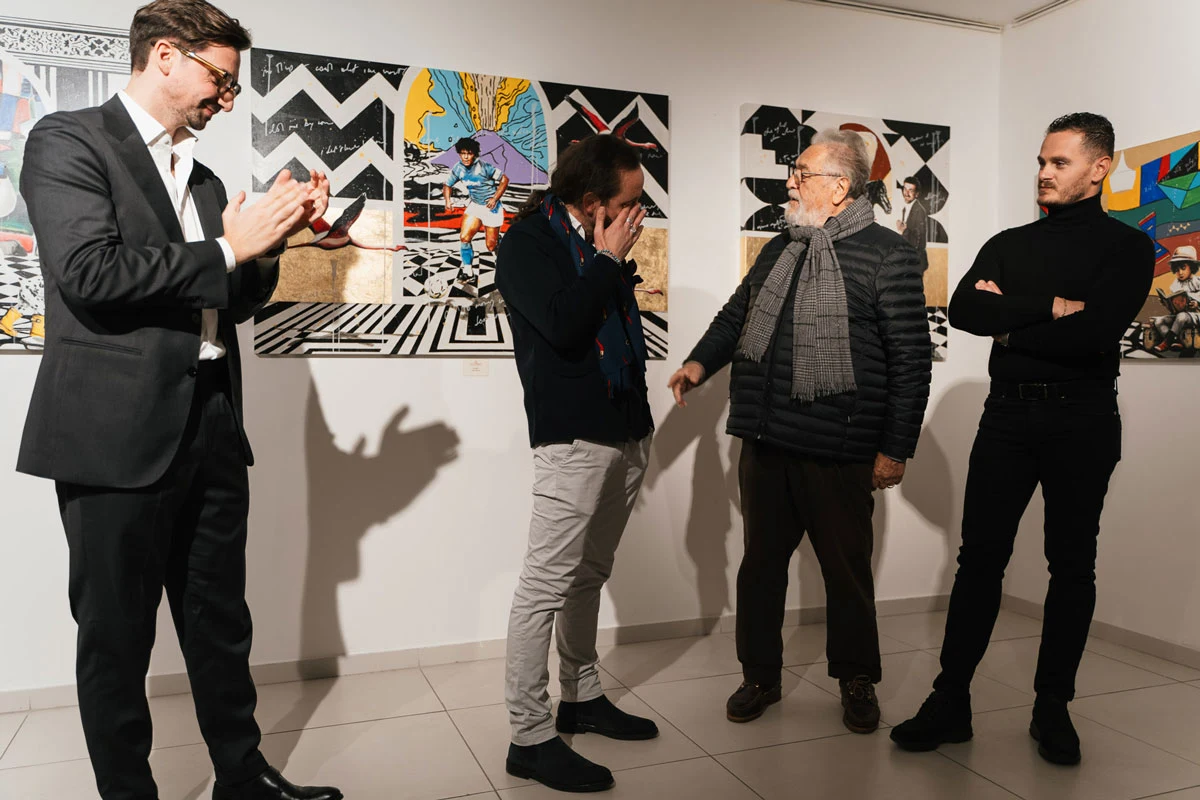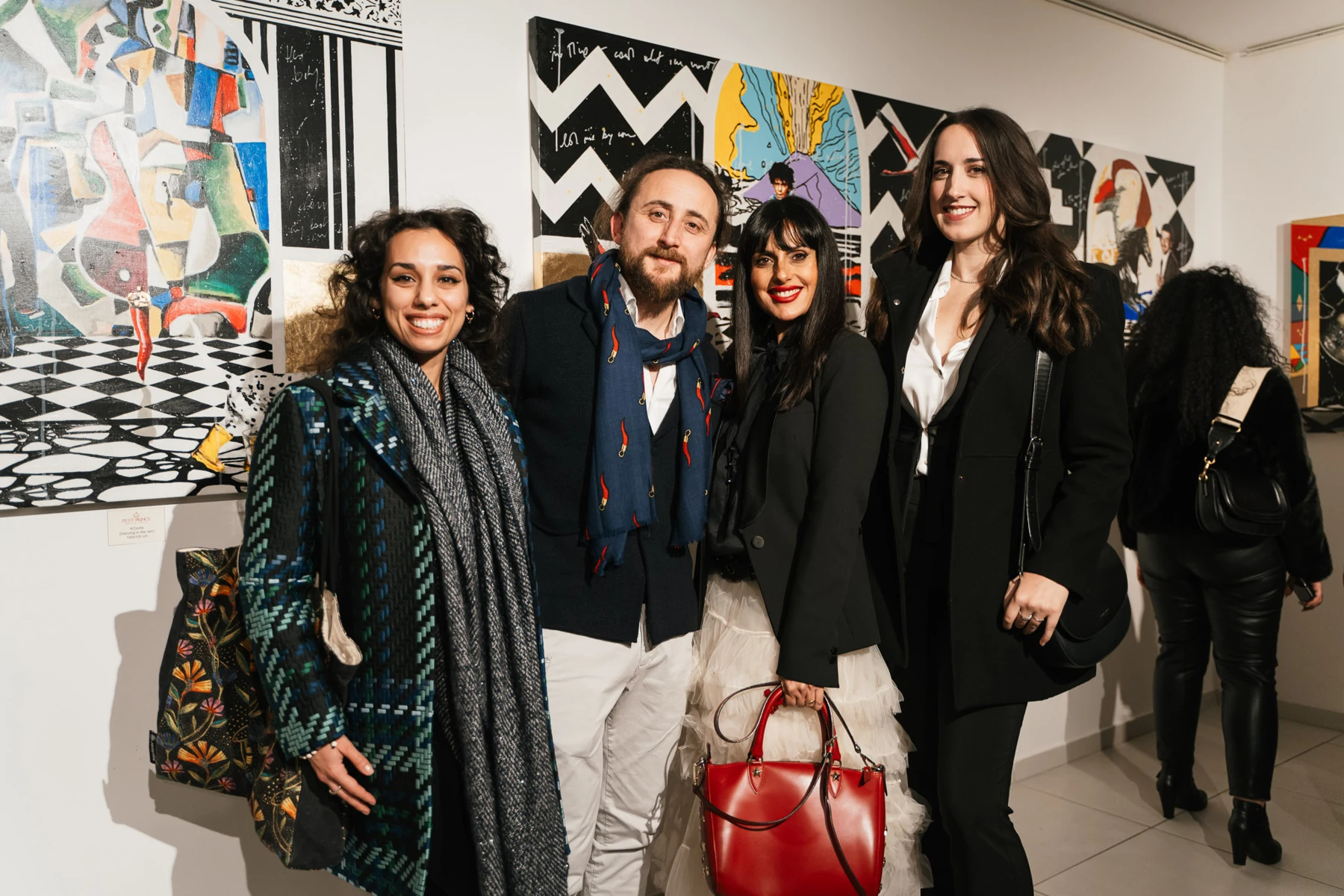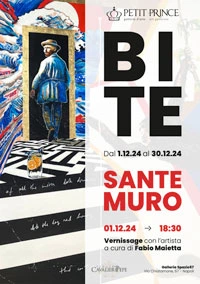
Sante Muro, a representative of the world of Pop art? That too, but to frame such a complex practice in these terms alone would be an inadequate simplification.
The presence of Pop elements in a work has more to do with a conceptual limitation on the viewer’s part than with the creativity of Sante Muro. Guided by his own sensibility, he devours the modern, contemporary world and gives it a colour of his own, much as an object in deep space absorbs matter before projecting it in a beam across millions of light years.
Sante Muro emits light, and colours are indeed light: light born of an intuitive feeling for art and art history, which he bites into with conviction — the bite of irony.
Biting conveys an intense sensation; irony disrupts equilibrium. If art history is a straight timeline, we might visualise irony as a line that rises and falls, crossing the boundaries of political correctness. In All the long redlines, for example, it confronts a Van Gogh seen from behind, reminding us that he is walking out of the door, leaving the stage. His departure is announced by a monkey hanging from a vine, its outstretched hand recalling the gesture of the deity in Michelangelo’s The Creation of Adam. Yet the monkey is placed on the right of the work, the position occupied by God in the immortal painting, as though to reverse the balance of power between the divine authority of history and the human artist.
The monkey-deity makes contact with the earthly world not through Van Gogh, the human, but through a glass: an irreverent invention that drives the irony by reversing the initial situation. And what is a monkey, after all, if not a distant relative of humankind? We might suppose that the primate also stands, symbolically, for humanity’s evolutionary journey. It is a reference that suggests moving beyond. Evolution is a surpassing that retains what came before, just as in Hegel’s dialectic of Aufhebung: to overcome while preserving.
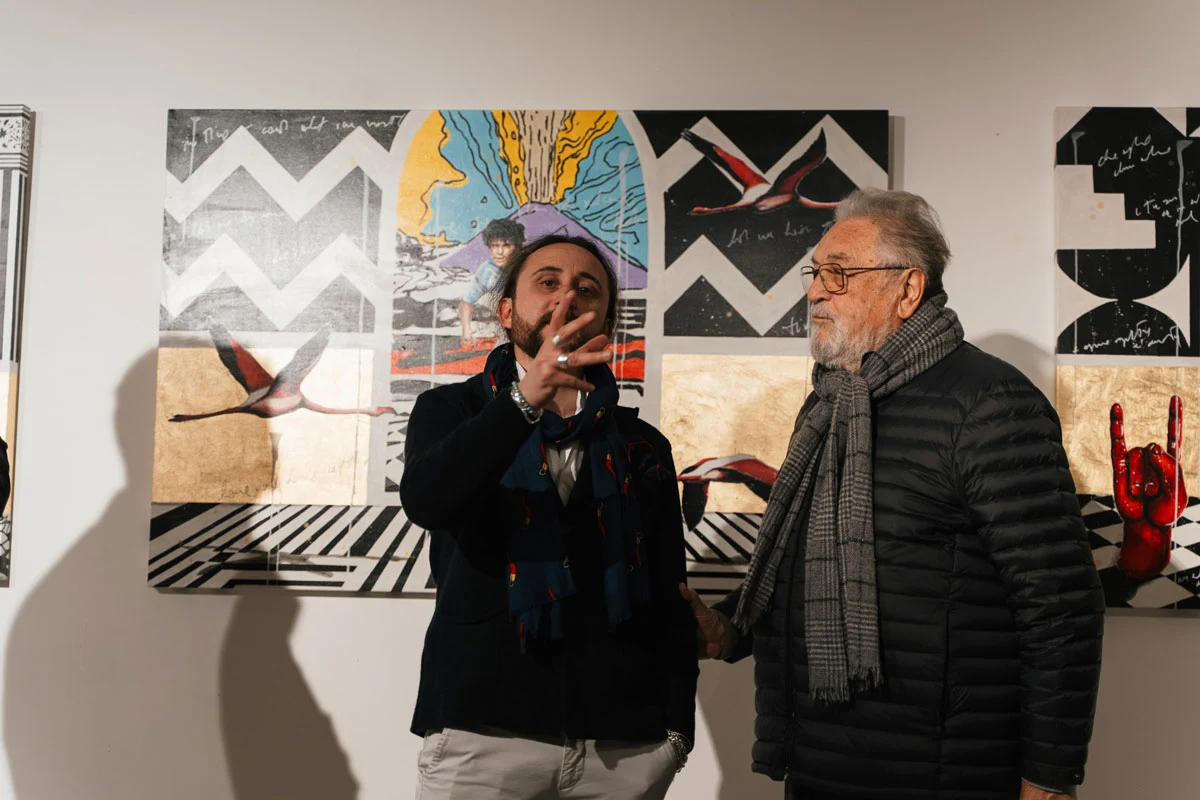
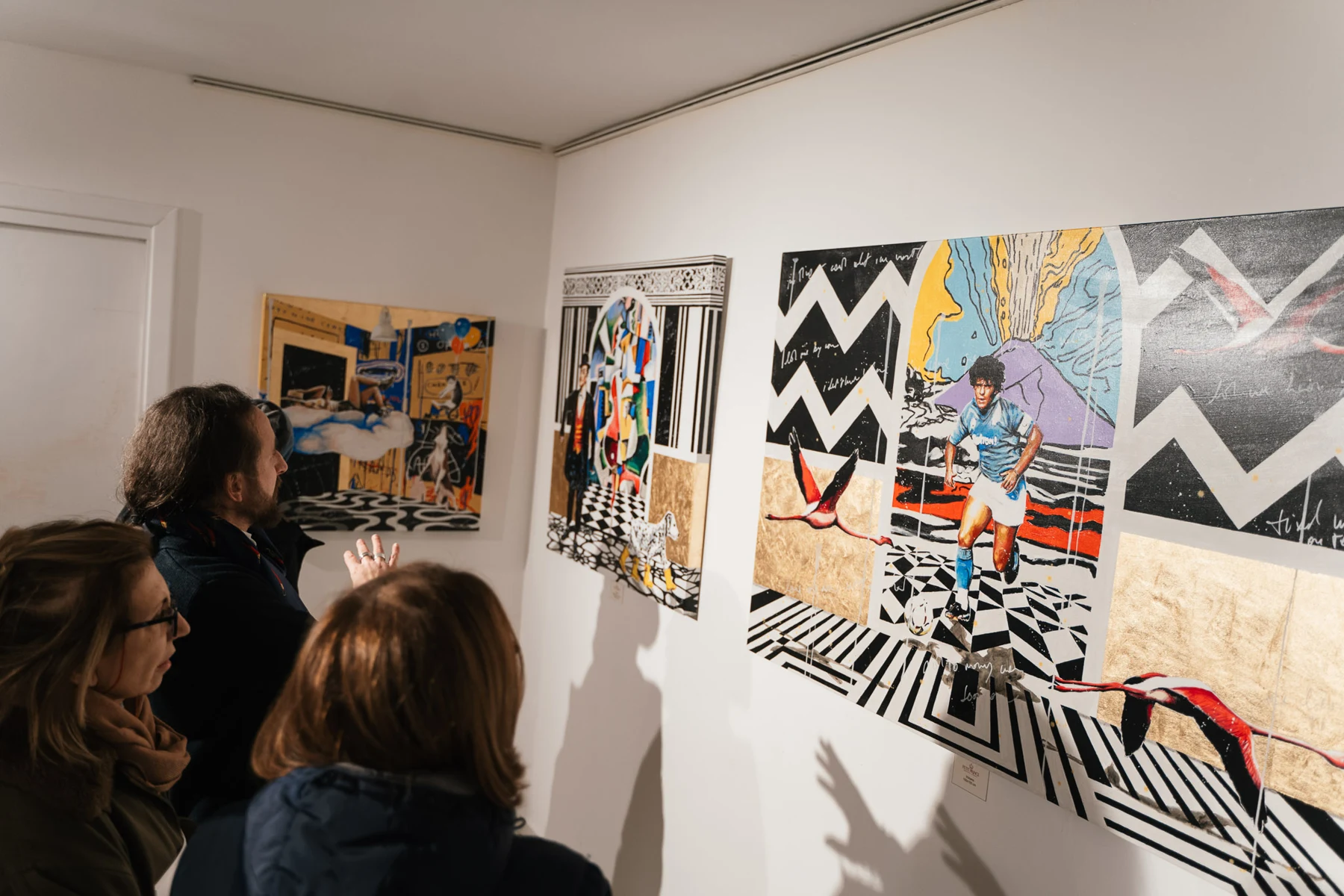
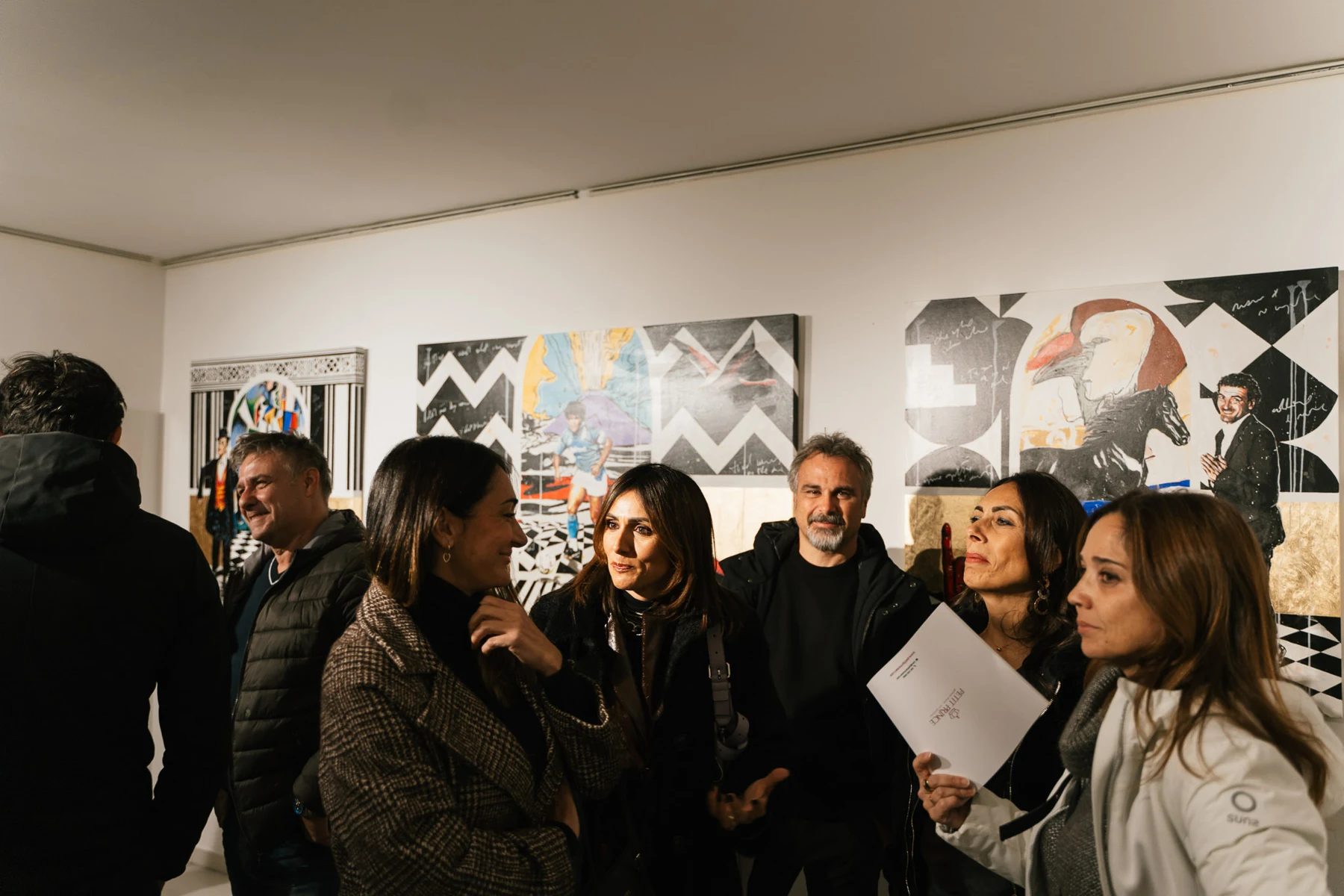
Then, in Volcano, comes the great energy of Naples, with its feeling, its heart and its passion: an unveiling of the city, like a lover undressing before making love, a deep, material union of substance that lives through the eruption of Vesuvius. From it, the figure of Maradona appears to take flight, occupying the centre of the composition as if to be immediately recognisable, while pink flamingos flank him — aquatic animals that symbolise the Neapolitan bond with the sea.
Elsewhere, this same irony conceals a barely perceptible veil of pain, a suffering that is not felt on the surface but points to itself through the protagonists of two works, Totò and Troisi. They embody a melancholy irony, a smile as broad as the vastness of the sea — the sea again, with its depths, depths that light sometimes struggles to reach.
Throughout Sante Muro’s work, this tension is never excessive, but is offered almost as a playful approach to life. This ironic, almost teasing attitude, which turns the world of modern simulacra upside down, finds its own expression in a deliberately provocative Pop spirit, using an accessible language to address complex questions such as the meaning of art today.
Sometimes art simply reproduces itself; at other times it has a new flavour. In this way, Sante Muro’s art has a generative force: it is new because it bursts into reality with an impulse towards transformation; it is anarchic because it cannot tolerate reverence for history. The past is a world that belongs to us because it is contained within the present. Yet, while containing what came before, the present world never coincides with its predecessor: it exceeds it, as in ecstasy, stepping outside itself. Otherwise, it would be a bluff.